What to Do When a Scared Cat Bites the Hand That Feeds It

If a scared cat bites the hand that feeds her, take your hand out of the equation and let the food arrive another way. Set the bowl down and step back, or slide it in with a long tool. The bite isn’t about the food or about you — it’s fear defending itself. You can keep feeding her without keeping your hand in range.
That single swap — from hand to tool — is how we got our terrified rescue, Yuja, to start eating in the first place. Here’s exactly how it went.
Why a frightened cat bites at feeding time
A scared cat isn’t attacking you. She’s cornered, and a hand appearing near her hiding spot reads as a predator, not a waiter. The food doesn’t cancel out the threat — from her point of view, a big warm thing just reached into the one place she felt safe.
When Yuja first came to us, she disappeared behind the washing machine and stayed there for about two weeks. We honestly don’t know the exact day she started coming out, because the gap was too narrow to see into. What we did know was that the food wasn’t going down. Our other cat, Mochi, was eating fine in the open the whole time. Same house, same people, opposite reaction.
So we had to get food to a cat who treated our hands like a threat.
The hand-to-tool swap that actually worked
At first I reached my arm behind the machine to set the bowl near her. I got hissed at every time, then scratched, then bitten. That’s when it clicked: the problem wasn’t the food, it was my hand in her space.
I switched to sliding the food and water bowls in with a long tool — think of long kitchen tongs or a reacher — so nothing of mine crossed into her zone. No arm, no risk, no reason for her to bite. The food still arrived. The next morning, the level had dropped a little. Then a little more the day after.
Here’s the mental shift that made the difference:
| Old approach | Swap | Why it works |
|---|---|---|
| Reach in by hand | Slide bowl with a long tool | Your hand never enters her defended space |
| Try to feed while she watches you | Set food, leave the room | Removes the pressure of being watched |
| Coax her out to eat | Feed her where she already is | She doesn’t have to choose between food and safety |
| Push a new food when she refuses | Offer what she’ll actually eat | Fear plus a strange food is a double no |
You lose nothing by removing your hand. She still eats, you don’t get bitten, and — this is the important part — she stops learning that your presence means a fight.
How to tell a hiding cat is eating
When a cat won’t come out and you can’t see her, a bitten hand and an empty room feel like failure. It isn’t. Watch for signals instead of stroking:
- Food and water levels. Refresh the bowl fully each time so you can see whether it actually went down, not just whether it got knocked around.
- The litter box. For us this was the real confirmation. One day there was noticeably more in the box, and that told us Yuja had been eating even though we’d never once seen her do it.
- Position changes. She won’t move while you watch, but overnight she might. Yuja eventually turned up on top of the fridge instead of behind the machine — a small sign she was willing to explore.
If a cat genuinely refuses all food and water for more than a day or so, that’s a vet call, not a patience test — a real fast can get dangerous fast, especially in cats. But a cat who’s eating on her own schedule behind furniture is usually just scared, not sick.
What not to do when a scared cat bites you
The instinct is to correct the bite. Don’t. Punishment reads as more threat and confirms exactly what she already believes about hands.
- Don’t reach back in to “show her it’s okay.” She can’t tell reassurance from another grab.
- Don’t corner her to make her eat in front of you. Eating and feeling watched are in direct conflict for a scared cat.
- Don’t rely on treats to buy her over. With Yuja this never worked — she’ll take a new treat once and then refuse it forever, so we gave up on treats as a trust currency entirely.
- Don’t chase progress. The one thing that reliably moved Yuja forward was doing less: feeding her, not pursuing her, and waiting. If you want the long version, we mapped the whole thing out in our 6-year trust timeline.
When the biting eases — and when it doesn’t
A few days in, Yuja stopped hissing as long as I didn’t get too close. That’s the middle stage most people miss: not full trust, but a conditional truce. She’d tolerate the tool if I kept my distance. That truce is the whole point of the swap — you’re not trying to win her over at feeding time, you’re just proving that food shows up and nothing bad follows.
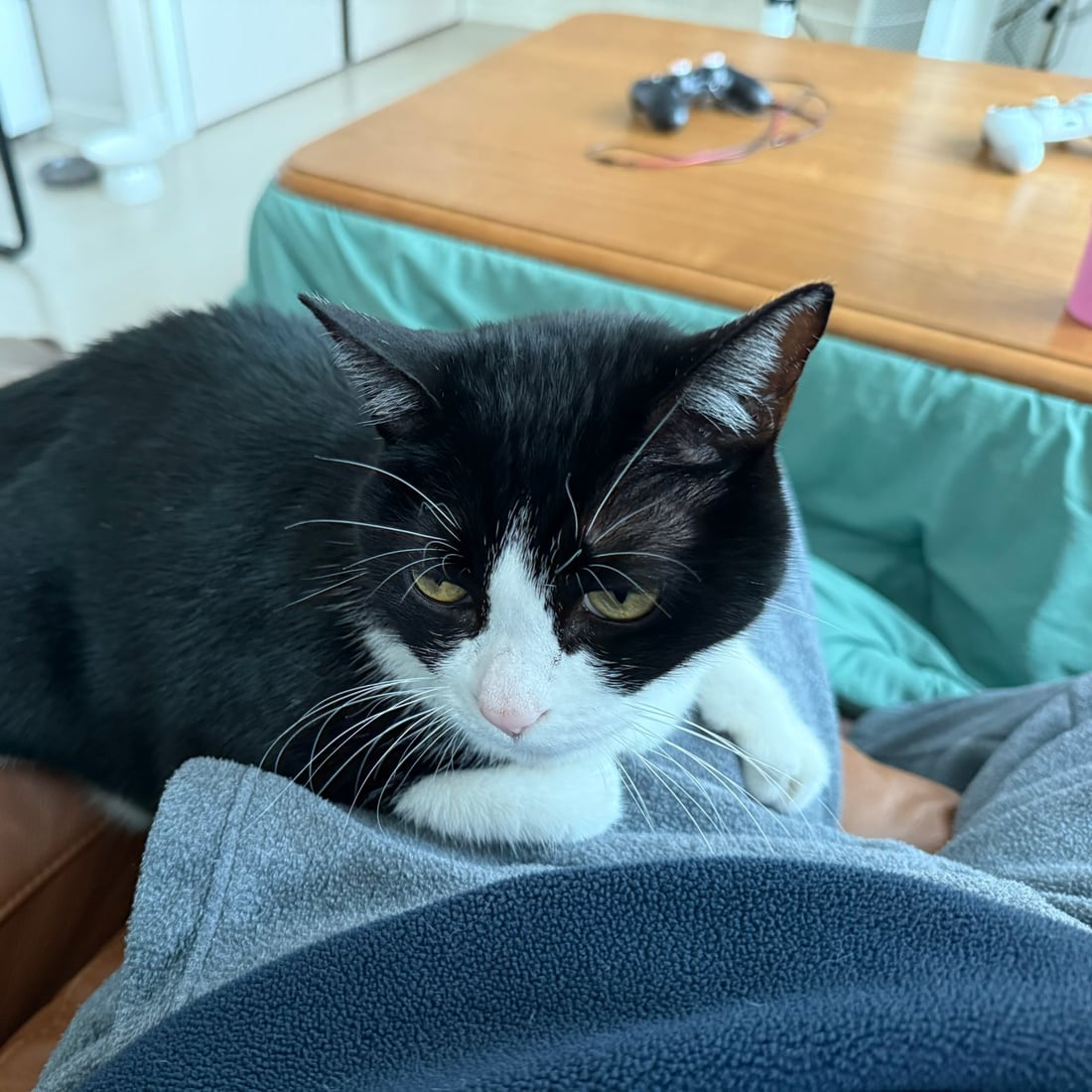
Be honest about the ceiling, though. Six years later Yuja lets me touch her paws, comes over to be scratched, and even purrs to demand attention. But she still won’t allow two strokes in a row without a warning bite, and I still can’t properly trim her nails. The feeding bite stopped years ago; her prickliness never fully did.
That’s not a failure. A scared cat who bites at feeding time can absolutely learn that mealtime is safe — usually within days or weeks once your hand is out of the picture. The deeper stuff takes longer, and some of it never fully arrives. If you’re wondering whether a jumpy cat mellows over time, we get into that in does a shy cat get friendlier with age.
The short version: don’t stop feeding her, and don’t fight her for it. Put the food where she is, take your hand out of range, and let the empty bowl do the talking. That’s how a hand that gets bitten slowly becomes a hand she’ll finally accept.
This article is general information from a cat owner, not veterinary advice. Talk to your vet about your cat's specific situation.