What to Do the First 24 Hours With a Rescue Cat

The first 24 hours with a rescue cat are mostly about restraint. Set up one quiet room with food, water, a litter box, and a place to hide, then open the carrier and step back. Let the cat come out on its own timeline. The urge to hold, comfort, and reassure is exactly the urge to resist — a scared cat reads attention as pressure.
That advice sounds passive, almost lazy. It isn’t. When Yuja came to us, the most helpful thing we did on day one was ignore her, and it took us a while to understand why.
What should I set up before the carrier opens?
Get the room ready first so you’re not scrambling once the cat is loose. You want one room, not the whole house. A frightened cat with access to a whole home just finds the worst possible hiding spot and disappears.
| Item | Why it matters day one |
|---|---|
| Food + water | Place them near the hiding spot, not in the open. A scared cat won’t cross a room to eat. |
| Litter box | Away from the food, but in the same small room so it’s easy to find. |
| A hiding spot | A cardboard box on its side, a covered bed, or just the gap behind furniture. Do not block it. |
| A worn t-shirt | Something that smells like you, left on the floor. Low-effort, sometimes helps. |
| Quiet | No TV, no vacuum, no guests. Sound is the enemy on day one. |
Keep other pets and kids out of that room entirely for the first day. The point is to shrink the cat’s world down to something it can handle.
Should I let the cat out of the carrier or wait?
Open the door and walk away. Don’t reach in, don’t tip the carrier, don’t coax with a treat held six inches from a terrified face.
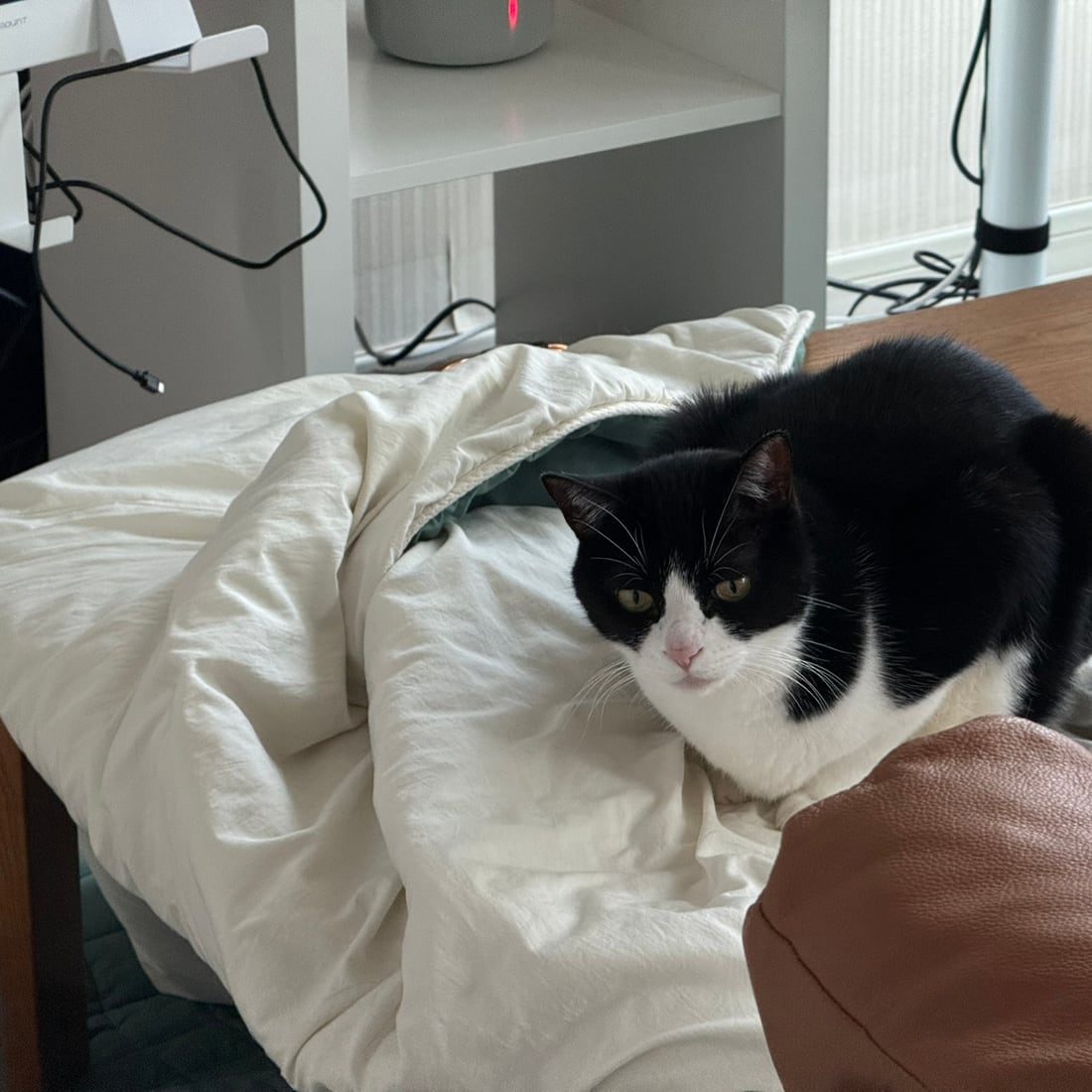
When Yuja arrived, she wouldn’t come out of the carrier. We left the door open and just went about unpacking, not even looking at her. By the time we finished, she was gone — we never saw her leave. We didn’t go looking, either. She’d found somewhere to feel safe, and on day one that’s the goal, not a problem.
Meanwhile Mochi, who came to us at the same time, was out and eating almost immediately. Same home, same people, opposite reactions. If you ever wonder whether two cats with completely opposite personalities is normal, the answer is very much yes — and you may see both extremes in a single afternoon.
What should I actually do the first day?
Do less than feels right. Here’s the split that took us too long to figure out:
Do:
- Talk normally around the room so the cat learns your voice.
- Leave food and water out and check later whether it’s touched.
- Let the cat hide as long as it wants.
- Keep to your ordinary routine — a calm, boring human is a safe human.
Don’t:
- Pull the cat out of a hiding spot to “reassure” it.
- Stare. Direct eye contact reads as a threat.
- Invite friends over to meet the new cat.
- Bathe, groom, or clip nails. None of that is day-one business.
The hardest part is resisting the rescue-story fantasy where the cat curls up in your lap that first evening. Some cats do. Most don’t. Yuja spent well over a week — honestly closer to two, though we can’t pin the exact day — living behind the washing machine before we saw her move to the top of the fridge. Six years later she still headbutts on her own terms only.
How do I know if the cat is eating and okay?
You often can’t watch a hidden cat eat, so you check the evidence instead. We couldn’t see behind the washer well at all, so we watched two things: whether the food level dropped overnight, and whether the litter box got used.
With Yuja, the food barely moved at first because Mochi was the one eating. So we brought the bowls to her — we set food and water right at the mouth of her hiding spot. The morning we noticed more waste in the litter box was the first real proof she was eating. That single observation told us more than any amount of hovering would have.
A quick honest note on health: a nervous cat skipping food on day one is common and usually not an emergency. But if a new cat eats nothing for more than a day or two, or you see vomiting, hard breathing, or complete limpness, that’s a vet call, not a wait-and-see. Trust your gut here.
When will the cat come out and act normal?
Longer than you hope, and there’s no fixed number. Some cats settle in a few days; deeply frightened ones take weeks or months. What matters in the first 24 hours is that you don’t set the relationship back by pushing.
The progression usually goes: total hiding → coming out only when you’re not around → tolerating you nearby if you don’t reach → approaching on the cat’s own terms. Yuja moved through all of those, but the first stretch felt like nothing was happening. It was. We just couldn’t see it.
If you want the honest long view of how slow and non-linear that trust curve is, we mapped our full six-year timeline with a formerly feral cat. The short version for day one: the whole strategy is presence without pursuit. Feed the cat, keep it safe, and wait. That’s genuinely most of the job.
Six years in, one of our two greets us at the door every day and the other still hisses if you pet her twice in a row. Both of those cats had the exact same first 24 hours — a quiet room and people who left them alone. Give a scared cat that, and you’ve done the first day right.
This article is general information from a cat owner, not veterinary advice. Talk to your vet about your cat's specific situation.