Should You Talk to a Scared Cat or Ignore Her?
Do both, at different moments. Talk quietly when you have to move near a scared cat, so your movement doesn’t catch her off guard. Act like you haven’t noticed her when she’s hiding, watching from cover, or working up the nerve to come out. The deciding factors are distance and who started the interaction.
Most advice picks one side. “Talk to her so she learns your voice.” “Ignore her so she doesn’t feel hunted.” Both are right, just not at the same time. Your job is to read which situation you’re in.
When to talk and when to ignore: a side-by-side
| Situation | Talk softly | Act like you didn’t see her |
|---|---|---|
| You have to walk past her hiding spot | ✅ A low, running narration warns her you’re moving | Fine if the path keeps you well away |
| She’s watching you from behind furniture or a curtain | Can feel like you’re calling her out | ✅ Go about your business and don’t look over |
| You need to do something loud or close (cleaning, moving things) | ✅ Steady voice before and during | ✅ Also works: no eye contact, finish quickly |
| She has just come out into the open | Stay quiet at first | ✅ Let her explore without an audience |
| She approaches you or sits near you | ✅ Quiet, short answers | Ignoring entirely can read as “nothing here for you” |
| She vocalizes at you or looks up at you | ✅ Answer her | Not the moment to go silent |
| She’s hissing, flattened, or tail lashing | Stop talking | ✅ Look away, back off, give space |
The pattern is that your voice is for warning and answering. Ignoring is for the moments when she’s still deciding. Talking works best when your body has to be near her anyway, or when she has already reached out. Ignoring works best when anything you do might feel like pressure.
Neither option includes reaching toward her, staring at her, or following her. Those cancel out whatever your voice or your indifference was doing.
Does talking to a scared cat calm her down?
Talking does help, but it’s less “your voice soothes her” and more “your voice makes you predictable.” A frightened cat is constantly tracking where the big animal in the room is and whether it’s coming closer. If you hum or murmur while you walk by, she doesn’t have to guess. If you go silent and then appear around a corner, you’ve startled her.
What makes a voice useful:
- Low and even. No high-pitched baby talk, no sudden “oh, there you are!”
- Continuous, not a single burst. One loud word followed by silence is more jarring than steady background murmuring.
- Not aimed at her. You can narrate what you’re doing (“just grabbing the laundry”) without turning to face her hiding spot.
One thing we’d caution against is expecting her name to do the work. Yuja doesn’t respond to her name. She never has. Calling a scared cat’s name is rarely what makes her feel safer. If your scared cat seems to ignore her name, that doesn’t mean talking is pointless. It means the tone and steadiness matter more than the word.
What does “ignoring” a scared cat actually look like?
Ignoring doesn’t mean being cold or leaving the room forever. It means staying around and staying ordinary while giving her nothing she has to react to.
In practice:
- Eyes elsewhere. Direct eye contact is one of the clearest signals of attention. Look at your phone, a book, the TV. If you do glance over, glance away slowly. A slow blink can help some cats, but don’t hold the look.
- Body angled away. Sitting sideways or with your back partly turned looks far less like stalking than facing her squarely.
- Low and still. Sitting on the floor across the room is usually less imposing than standing over a spot.
- Normal routine. Cook, read, fold laundry. A predictable household tells her more than any amount of coaxing.
The goal is to be present but not interested. She gets to study you without being studied back. For a cat that’s tucked behind a chair or curtain with only her face showing, that’s often exactly what she’s doing: watching to see whether you’ll come after her. When you don’t, she learns something. It’s the same reason pulling a hiding cat out of her spot tends to set things back. The pressure is the problem, not the hiding.
How to tell which one she’s asking for
The table is the starting point. Her behavior should fine-tune it. Some signals that point one way or the other:
Go quiet and look away if:
- Her ears turn sideways or flatten when you speak
- She shrinks back farther into cover when you talk
- Her pupils widen or her tail starts flicking
- She hisses (stop everything and give distance)
Answer her if:
- She comes into the room on her own and settles somewhere visible
- She sits and watches you without crouching
- She vocalizes toward you
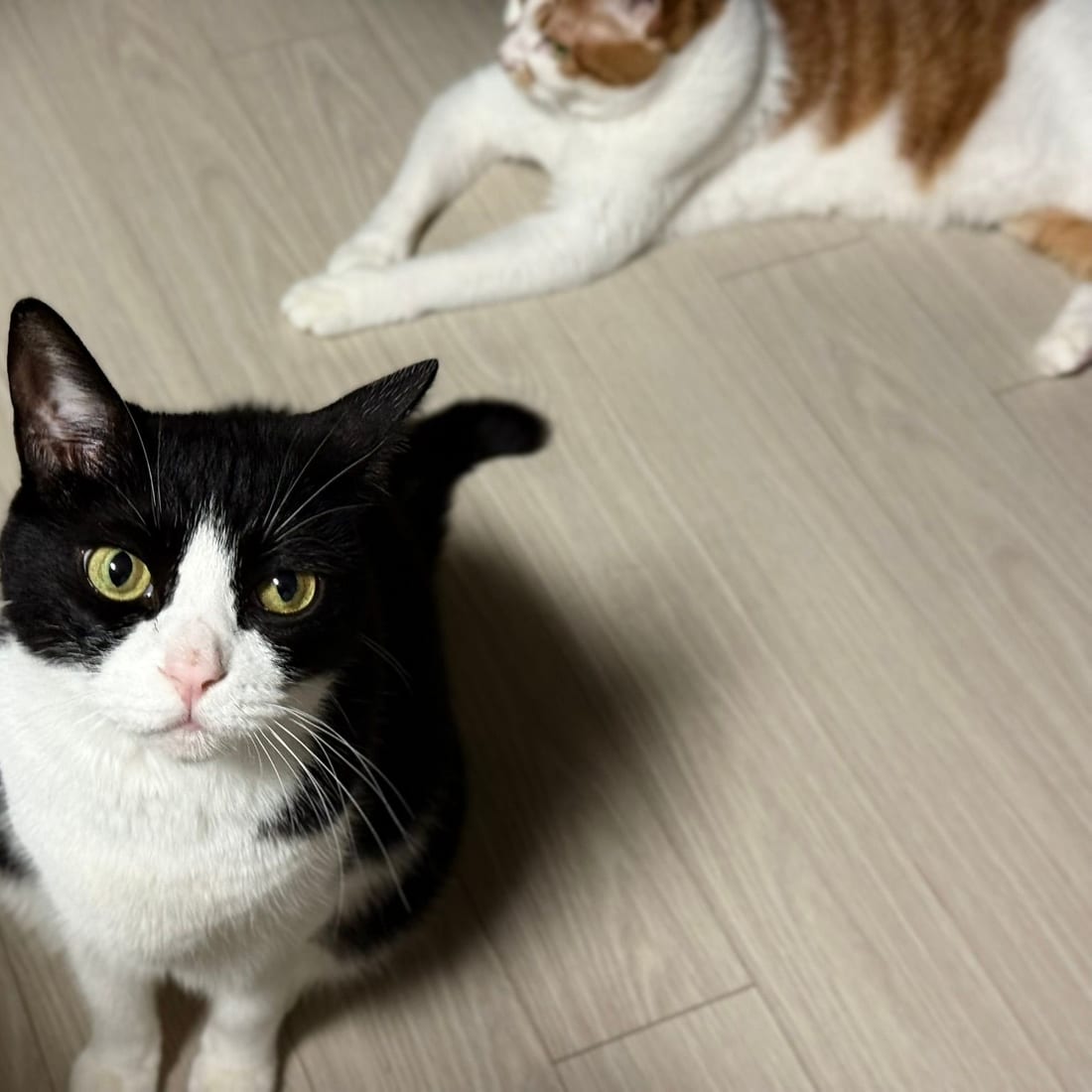
That last one is the clearest invitation. Yuja does something we have a lot of photos of: she sits on the floor, tilts her head back, and looks straight up at whoever’s there, sometimes with her mouth open mid-meow. That’s not a cat who wants to be pretended away. It’s a cat starting the conversation. When a cat that usually hides does this, respond with a few quiet words. That’s a reasonable reply. Reaching down to scoop her up is not.
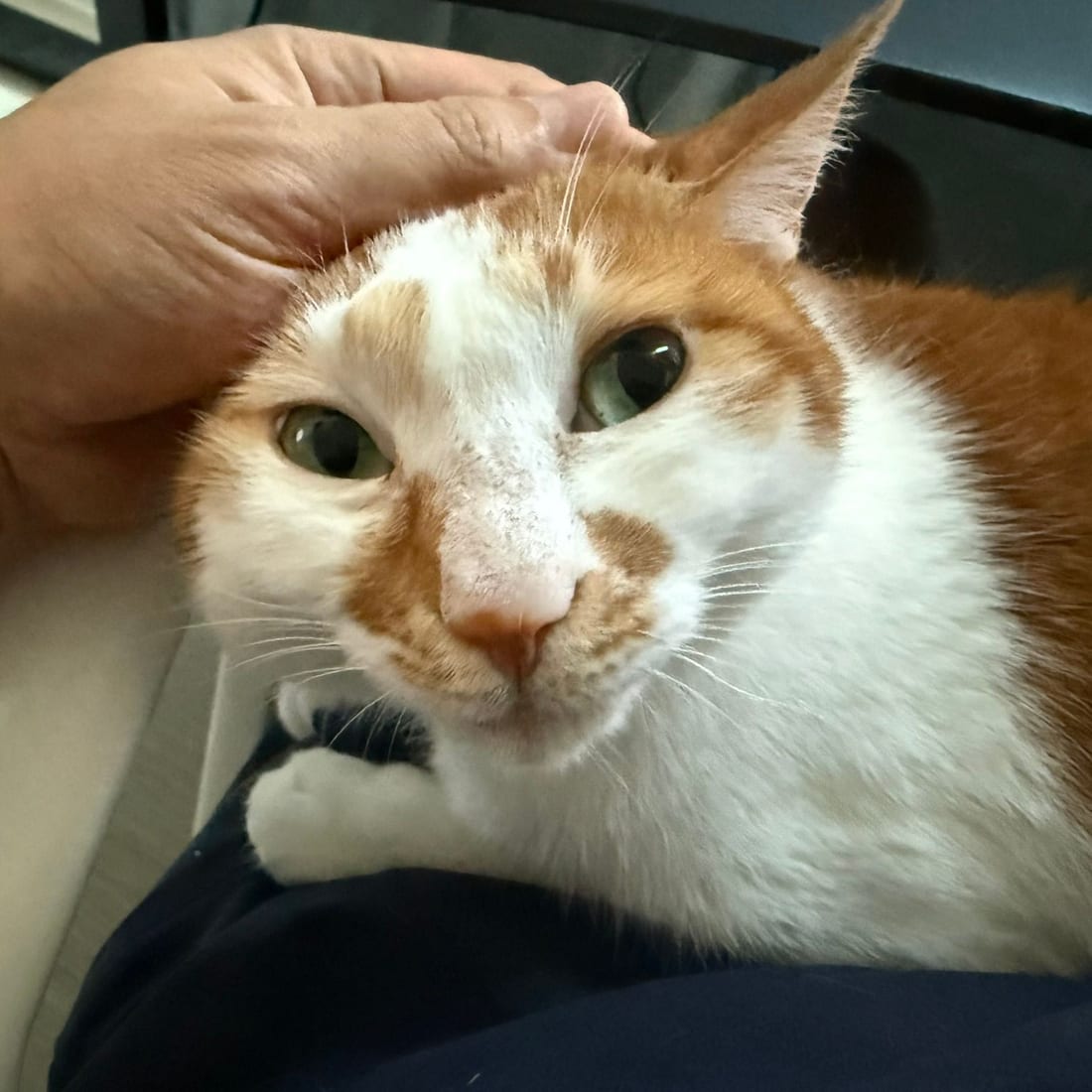
For contrast, Mochi doesn’t need any of this calculation. She’ll walk up to you whether you’re talking or not. If you have one cat like that and one like Yuja, the table above is only for the second cat.
When neither seems to work
Some cats stay flattened no matter how quietly you talk or how thoroughly you ignore them, especially in the first days in a new home. That usually just means it’s early. Keep the routine boring and give it more time. Don’t keep trying new tactics every hour.
Two things are worth watching:
- Is she eating, drinking, and using the litter box? A scared cat that’s hiding but eating is in a very different place than one that has stopped. If she isn’t eating, call your vet rather than waiting it out.
- Is the fear new? A cat that has been relaxed for a long time and suddenly starts hiding and hissing may be in pain or unwell. That’s worth a vet visit before you treat it as a trust problem.
Otherwise, the rule of thumb holds. Use your voice to warn her and to answer her. Use your silence to let her decide. Leave the timing to her.
This article is general information from a cat owner, not veterinary advice. Talk to your vet about your cat's specific situation.