When Is It Safe to Try Touching a New Rescue Cat?
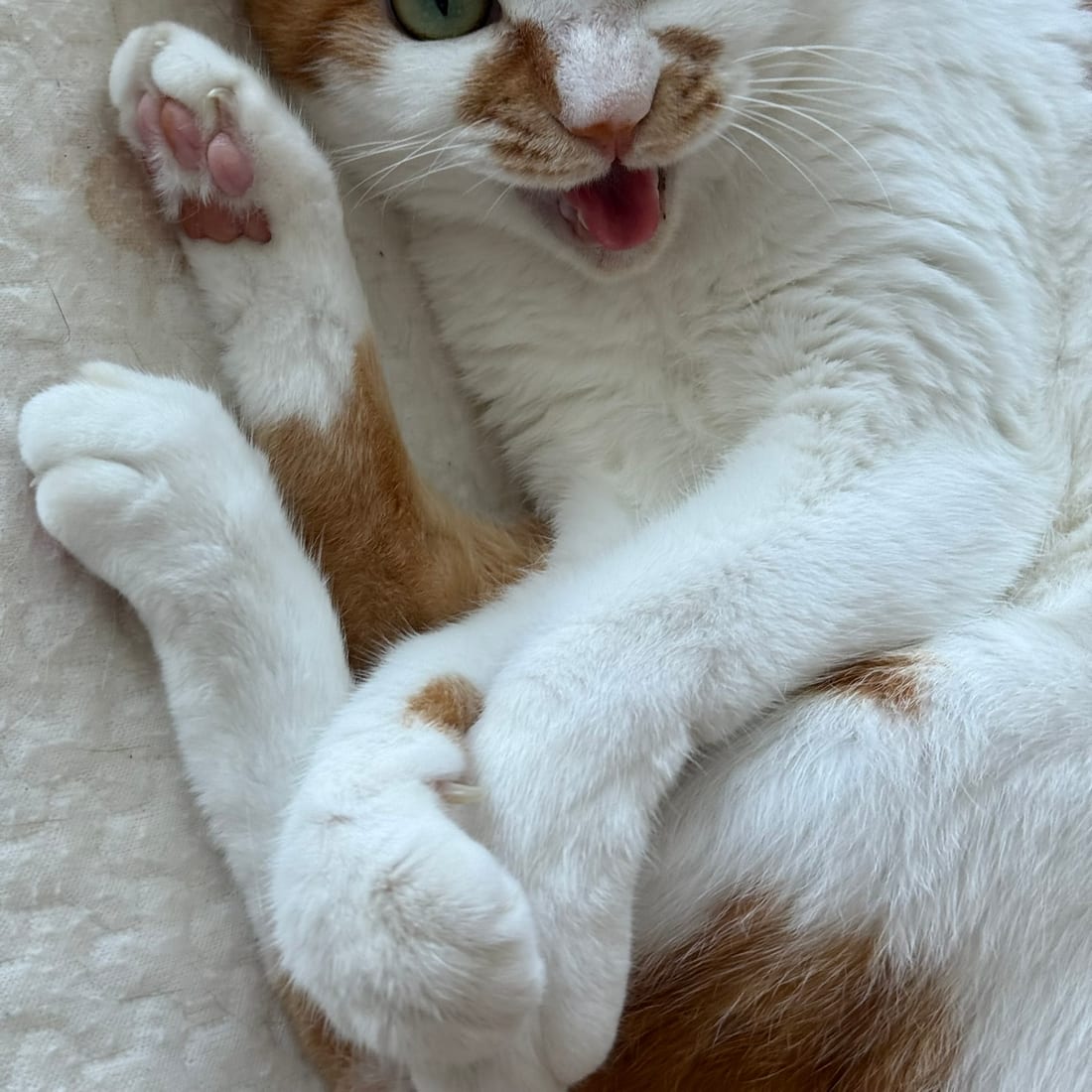
Wait until the cat comes to you — not the other way around. A new rescue cat is ready for you to try touching her when she chooses to be near you, eats calmly while you’re in the room, and holds still instead of fleeing when you shift your weight. Reaching before those signals show up usually costs you weeks.
That’s the short version. The longer version is that “safe to touch” and “settled in” are two different milestones, and people mix them up all the time.
Settling in is not the same as being ready to touch
A cat can look settled — using the litter box, eating, sleeping in the open — and still not want your hands anywhere near her. Those are signs she feels physically safe in the space. They are not permission.
When Yuja first came to us, she vanished behind the washing machine for a little over ten days. We honestly don’t know the exact day she started coming out, because we couldn’t see back there well. Even after she moved to the top of the fridge and was clearly eating, she’d hiss if we so much as walked past. She was “settled” in the sense that she was surviving. Touch was still years off — full paw contact took four years, and even now, two strokes in a row and she’ll nip.
So separate the two questions. First: does she feel safe in the room? Then, much later: does she want contact? Rushing from the first to the second is where most people go wrong.
What signals mean she’s ready to try?
The cat should be showing you she wants to close the gap, not just tolerating you. Look for the cat doing the approaching.
| Green light — try a gentle offer | Red light — wait |
|---|---|
| Comes toward you on her own | Only relaxes when you’re gone |
| Eats calmly while you sit nearby | Stops eating when you enter |
| Stays in the room as you move around | Bolts the moment you shift |
| Blinks slowly, loafs with paws tucked | Ears back, crouched, tail flat |
| Sniffs your still hand and stays | Hisses, swats, or freezes stiff |
Mochi, our confident one, hit the green column in days — she’d flop and roll before we ever reached for her. Yuja climbed those rungs one at a time over years. Same house, same people, opposite timelines. If your two cats are wildly different, that gap is completely normal.
The key word is willingly. A cat who’s cornered may hold still because she’s frozen, not because she’s comfortable. That’s why you always let her set the distance.
How to make the first attempt
When the green signals are steady, keep the first try tiny and let her opt out.
- Sit at her level and stay boring. No looming over her. Sideways, low, unhurried.
- Offer a still hand. Hold it a few inches from her, at nose height, and let it sit. Don’t push it toward her face — that reads as a grab.
- Let her sniff and decide. If she leans in, good. If she leans away, you have your answer.
- Aim for the cheek or the base of the ears first. Skip the belly, tail, and paws — those are the last places a nervous cat surrenders.
- One or two strokes, then stop. End before she wants you to, not after. Quitting while she’s still relaxed is what makes her come back.
That last point matters more than any technique. Yuja will actually sit next to me in a loaf and start purring before I’ve touched her — for her, the purr isn’t contentment, it’s a request to be scratched. But push past a couple of strokes and she still bites and leaves. Reading the exit signal is as important as reading the invitation. If your cat does this mid-pet, we wrote about why she bites while you’re petting her.
What if she hisses or bolts?
Back off. A hiss is not a personality flaw or aggression — it’s plain information: not yet, not like this. The worst thing you can do is push through it, because now you’ve taught her that hanging around you means getting grabbed.
Our whole approach with Yuja came down to one sentence: don’t chase, keep caring, and wait. When she hissed at the food bowl, we still delivered the bowl — just with tongs at first, since reaching in got us scratched. We didn’t take the hiss personally and we didn’t retreat from feeding her. We only retreated from touching her.
If a normally calm cat suddenly starts flinching from a spot she used to let you handle, that’s worth a vet visit — sudden touch sensitivity can be pain rather than mood. But for a brand-new rescue who’s never trusted you yet, a hiss is just the current honest answer.
How long does this take?
Longer than you want, and there’s no clean number. Some cats warm up in a week. Others take months. Yuja took four years to let us touch her paws at all, and she still runs the show. Mochi needed no runway.
Here’s the reassuring part: waiting almost never hurts. Rushing does. A cat who’s allowed to set the pace tends to arrive sooner than one who’s been grabbed before she was ready and now keeps her guard up. You are not falling behind by going slow — going slow is the method.
So the honest answer to “when is it safe to try” is: when she’s already halfway to you. Your job until then is to be a calm, predictable, boring presence who feeds her and lets her breathe. The moment she decides you’re worth approaching, you’ll know — and that’s the moment to offer a quiet hand and see what she says.
This article is general information from a cat owner, not veterinary advice. Talk to your vet about your cat's specific situation.