Do Nervous Cats Still Want to Watch the Window?
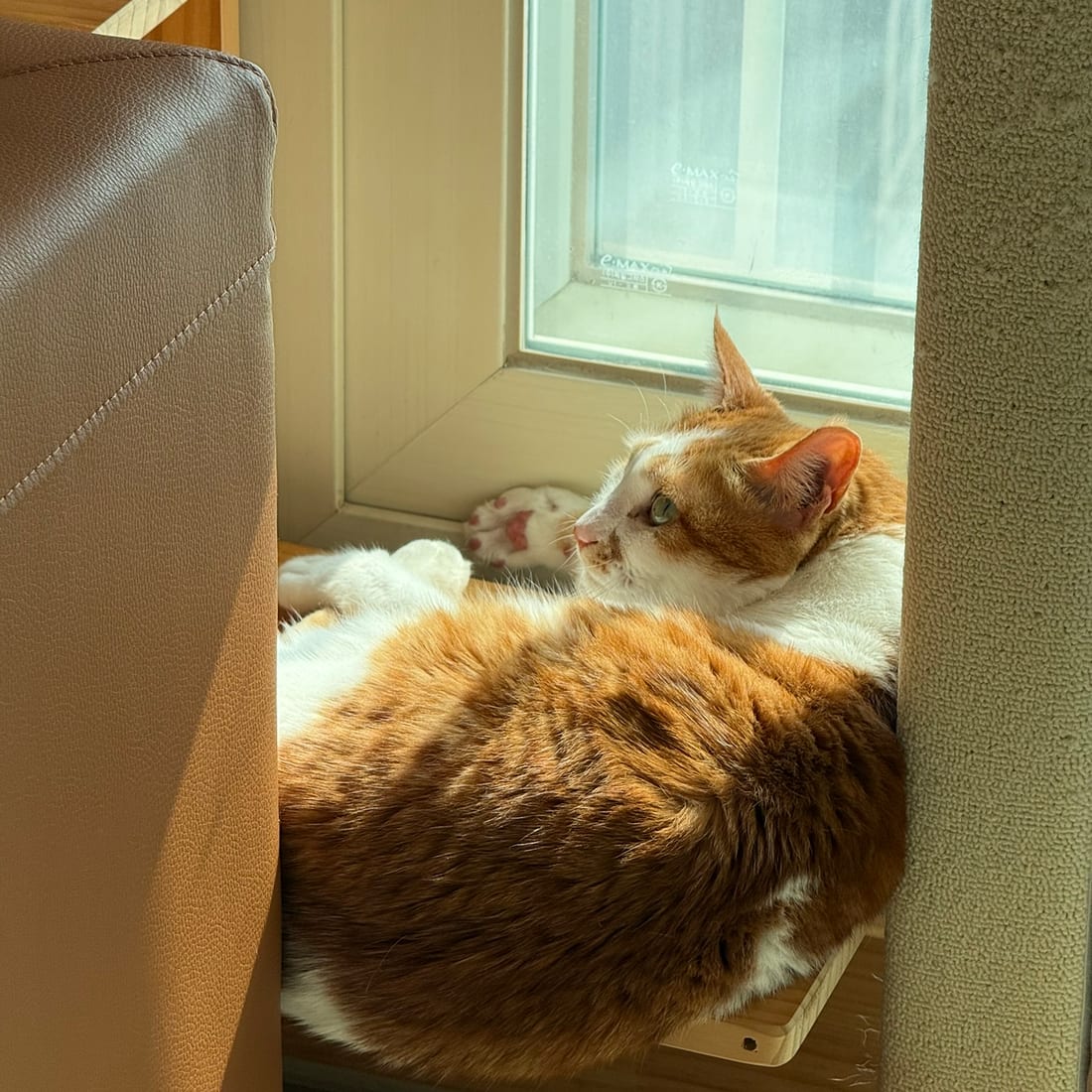
Yes — nervous cats often love watching the window as much as, or more than, confident ones. A window gives them the one thing fear takes away: a full view of the world where nothing can reach them and they can leave the second they want to. For a jumpy cat, that combination of information and safety is exactly what she’s looking for.
Our shy one, Yuja, proves it every day. This is a cat who spent about two weeks behind the washing machine when she first came to us, who still can’t take two pets in a row without hissing. And she’ll sit at the window for a solid hour, watching birds and cars with total calm. The window is one of the few places her guard drops.
Why does a scared cat feel safe at the window?
Fear in cats is mostly about control. When something can move toward them unpredictably — a hand, a guest, a plastic bag — they bolt. The window removes that variable. Whatever’s out there stays out there, on the far side of the glass, and your cat gets to observe it on her own terms.
Three things make window-watching low-stress even for anxious cats:
| What the window offers | Why it calms a nervous cat |
|---|---|
| A wide, elevated view | She sees threats coming; nothing surprises her |
| A barrier she trusts | Movement outside can’t actually reach her |
| An easy exit | She’s never cornered — she can leave anytime |
| Passive engagement | She stays alert without having to interact |
Compare that to how the same cat reacts to a visitor. Yuja disappears the moment the doorbell rings, which is its own whole thing we wrote about in why cats hide when guests come over. The difference isn’t that she hates stimulation. It’s that the window gives her stimulation she can control, and a guest doesn’t.
Do nervous cats watch differently than confident cats?
They do, and the difference is worth learning to read. Our confident cat, Mochi, watches the window the way she plays — chattering at birds, tail flicking, ready to launch. She treats the glass like a hunting opportunity that just happens to be out of reach.
Yuja watches like a lookout. Still body, quiet, eyes tracking. She’s not gearing up to pounce; she’s gathering information. If a plastic bag rustles somewhere in the house, that calm evaporates instantly — but a squirrel three feet away on the other side of the glass barely earns a tail twitch.
That tells you something useful: for a nervous cat, the window is often a refuge, not a hunting ground. She’s not overstimulated there. She’s decompressing. So if your anxious cat gravitates to a windowsill and just sits, that’s not boredom. That’s her finding a spot where she can finally relax her shoulders.

Where should you put a perch for an anxious cat?
Location matters more than the perch itself. A nervous cat will ignore a beautiful window seat in a busy hallway and adopt a folded blanket on a quiet sill instead. Put the view where she already feels secure, not where you think it looks nice.
What’s worked for us and what hasn’t:
- Give it a wall behind it. A perch with her back protected feels safer than one exposed on all sides. Yuja won’t use anything she can be approached from behind.
- Pick a low-traffic window. The one people constantly walk past defeats the purpose. She wants to watch the outside world, not brace for foot traffic inside.
- Keep it rock-solid. A wobbly suction-cup shelf that shifts under her weight will spook a jumpy cat once and she’ll never trust it again. Stable beats fancy.
- Let her opt in. Don’t lift her onto it. Set it up, walk away, and let her discover it on her own timeline. Yuja took days to try a new spot even when she clearly wanted to.
You don’t need to buy anything special, either. A sturdy chair or the back of a couch pushed under a window works. Cats care about the view and the stability, not the price tag — the same reason so many of them ignore the expensive bed and sleep on a chair.
When window-watching turns into stress
Most of the time, a window is pure enrichment. But watch for a few situations where it tips into something harder for a nervous cat to handle.
The big one is an outdoor cat parked right outside. A stray sitting on your porch, staring back, can genuinely stress an indoor cat — she can see the “intruder” but can’t do anything about it. That frustration sometimes gets redirected at whoever’s nearby, which is how a peaceful window session turns into a hiss at a housemate cat. If you see this, temporarily blocking that lower part of the window (a curtain, frosted film) usually settles things faster than trying to intervene.
The other thing to notice: a sudden change in a cat who used to love her window. If a cat who’s watched the same window happily for years suddenly avoids it, hides more, or seems generally off, that’s worth a vet visit — a shift like that can be about how she’s feeling physically, not the view.
But for the everyday nervous cat who just wants somewhere quiet to observe the world? The window is one of the kindest, lowest-effort gifts you can give her. It asks nothing of her, threatens nothing, and lets her participate in life from behind a barrier she trusts completely.
What this taught us about our shy cat
Six years in, we’ve learned to read Yuja’s comfort by where she chooses to be. The washing machine was terror. The top of the fridge was cautious retreat. The window is the first place we ever saw her look genuinely at ease with her guard down.
That progression matters. A nervous cat who claims a window spot is showing you she feels safe enough in your home to stop scanning for exits and just watch. It’s not a dramatic milestone like a lap sit. It’s quieter than that. But if your anxious cat is spending real time at the glass, calm and curious, take it as the good sign it is — she’s found her window on the world, and she trusts you enough to enjoy it.
This article is general information from a cat owner, not veterinary advice. Talk to your vet about your cat's specific situation.