Why Your Cat Sits Near You But Never On You
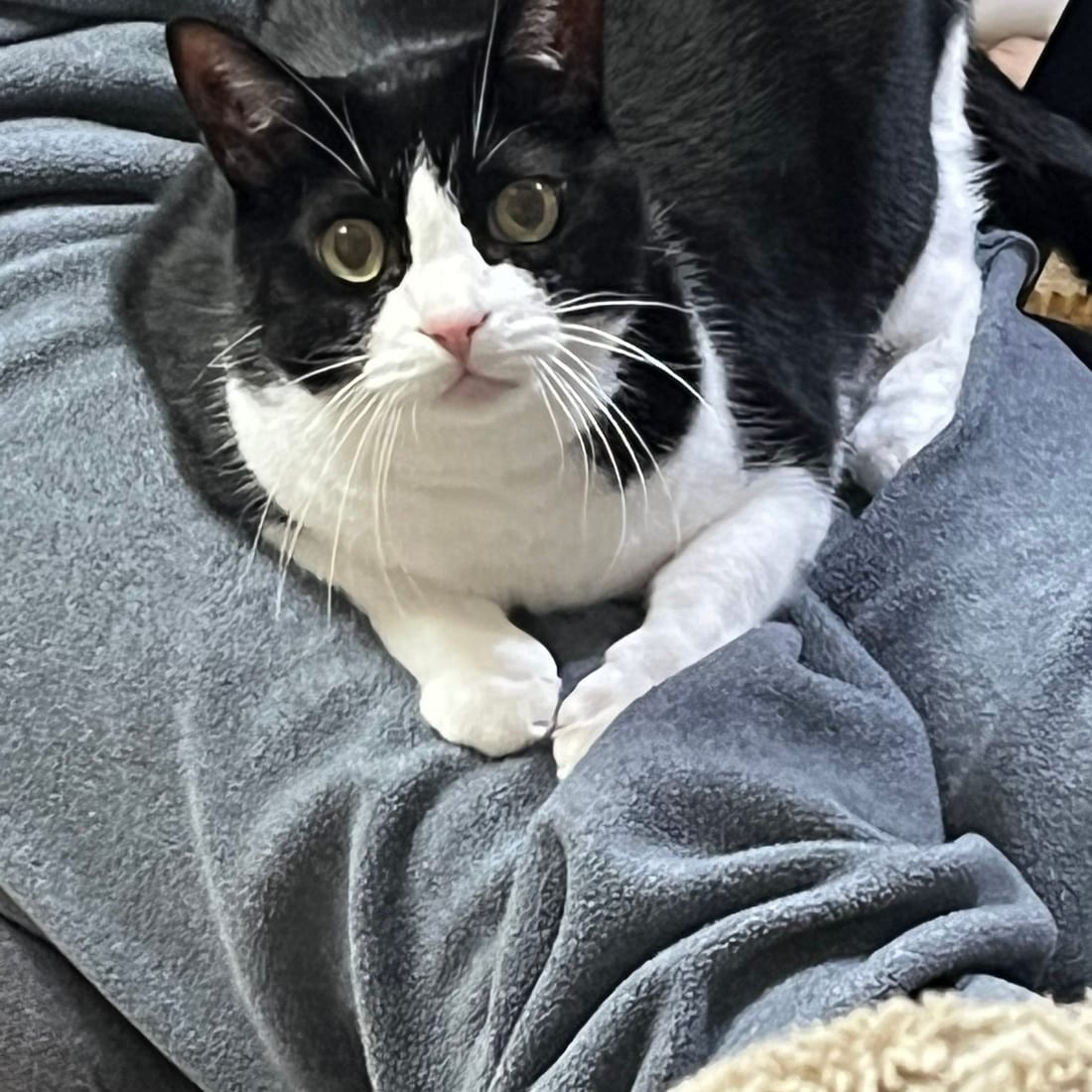
A cat that sits near you but never on you is usually choosing closeness while still keeping control of the contact. Proximity is a decision it makes freely; a lap means being held in place, which is a different, bigger ask. For most cats — especially rescues — nearness comes long before (and sometimes instead of) lap-sitting, and that’s a normal, healthy place to land.
In other words, the cat already trusts you. It just hasn’t signed up for the part where it can’t leave instantly.
What is the cat actually telling you?
When a cat picks a spot three feet away and settles in, it’s making a quiet statement: this person is safe to be around. Distance is the one variable a cat can fully control, so where it chooses to sit is honest information.
A lap is a different category. On your lap, the exits are slower. Your hands are right there. If something startles the cat, it can’t vanish in half a second. For a confident, laid-back cat that’s no big deal. For a cat that runs anxious — or spent part of its life outdoors where fast escapes mattered — it’s a lot to give up.
So “near but not on” isn’t a half-measure. It’s often the cat’s actual comfort ceiling, and it’s a real one.
Why some cats stop at “near” and never go further
Our two cats landed in completely different places on this, same home, same people.
Mochi, the tuxedo, is the lap cat. She crawls up, curls into a ball, and looks up at us. She’ll flop over on a knee and fall asleep with her face buried in a sleeve. For her, a lap is just another good spot.
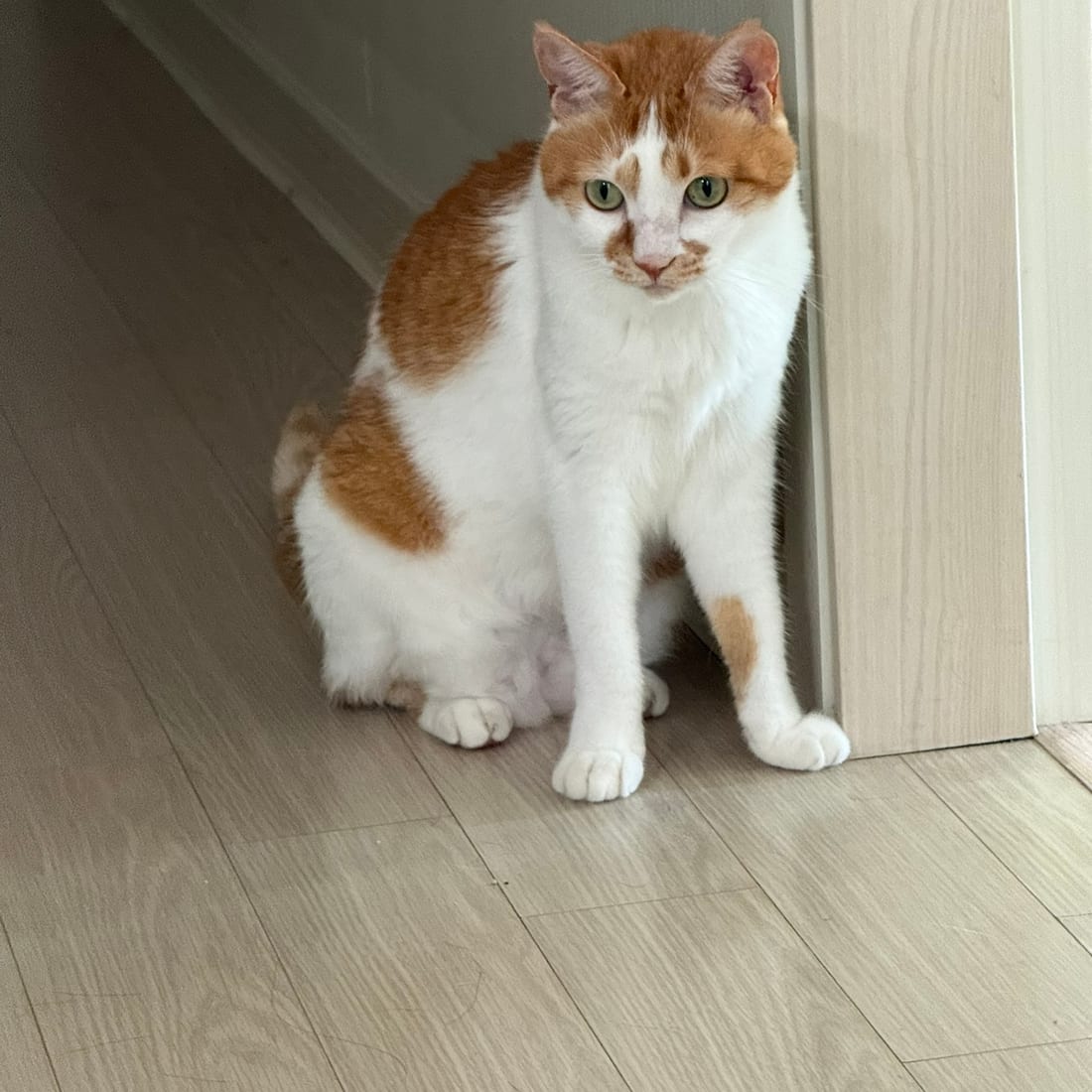
Yuja is the one who taught us that “near” can be the whole story. She hid behind the washing machine for a little over ten days when she first came to us — we honestly don’t know the exact day she came out. It took four years before we could even touch her paws. Today she’ll climb into a lap, roll over, show her belly, and push her cheek into a palm. But she also bites and bolts if you pet her too long. Her trust is real and it’s conditional, both at once.
The point: a cat sitting near you may be at its endpoint, or it may be mid-journey. There’s no reliable way to tell which from the outside. What you can do is make the near-spot a good place to be.
Near vs. on your lap: what each one means
| Behavior | What it usually signals | What it does NOT mean |
|---|---|---|
| Sits a few feet away | Trusts you enough to relax nearby | That the cat is “almost” a lap cat |
| Sits touching your leg | Wants contact on its own terms | That you can now pick it up |
| Sleeps in the same room | Feels safe sharing space | That it wants to be petted while asleep |
| Climbs onto your lap | High comfort, low flight instinct | That it will stay if you hold it there |
| Comes near, then leaves | Checking in, topping up on closeness | Rejection |
The row that trips people up most is the last one. A cat that drifts over, sits for ninety seconds, then wanders off isn’t losing interest in you — it’s doing laps of reassurance. Mochi does a version of this all day. Yuja does a slower, more guarded version. Both are fine.
How do I get a near-cat to come closer?
You mostly don’t get them to. You remove the reasons not to, and you wait. Here’s what has actually moved the needle for us:
- Don’t reach. The fastest way to freeze progress is to grab for a cat the moment it’s within arm’s length. Let it sit there without a hand coming at it.
- Stay boring. Cats close distance toward calm, predictable people. Reading, scrolling, working — low-energy activities invite a cat over more than coaxing does.
- Let the cat set the contact. When Yuja wants to be scratched, she parks herself in a loaf nearby and purrs before we touch her — for her that purr is a “pay attention to me” request, not a contentment sound. We let her come to us, and we stop before she’s done, not after.
- Keep sessions short. With a cat that bites when overstimulated, ending early is how you keep the near-spot positive. Two good seconds beat ten that end in a nip.
If you want the longer version of how this plays out over years rather than weeks, we wrote it up in our six-year timeline of earning a formerly feral cat’s trust.
When “near but not on” is worth a second look
This behavior is almost always normal. The one thing worth noticing is a sudden change in a cat that used to be more affectionate. If a cat that happily sat near you — or on you — abruptly keeps its distance, hides more, or flinches when you move, that can be about pain rather than mood, and a quick vet check is the fastest way to rule it out.
Barring that, a cat that simply prefers your side to your lap isn’t a project to fix. Plenty of deeply bonded cats never become lap cats. We’d rather have Yuja choose to sit near us on her terms than force her onto a knee and lose the trust it took years to build. If you’re hoping that line eventually gets crossed, our honest take is in whether a rescue cat will ever sit on your lap.
The lap is a bonus. The sitting-near is the relationship.
This article is general information from a cat owner, not veterinary advice. Talk to your vet about your cat's specific situation.