Do Cats Learn Behaviors From Each Other?
Yes, cats learn behaviors from watching each other — it’s called social or observational learning, and it’s well documented. A cat sees another cat do something, notices it works, and tries it. But here’s the catch we learned firsthand: a cat can copy the action and completely miss the point.
We’ve watched it happen in our own house, and it turned out weirder than the textbook version.
What cats actually learn from each other
Cats aren’t pack animals, but they’re social enough to notice what works for the cat next to them. In multi-cat homes, the most commonly copied behaviors are the practical ones — where the food shows up, which spots are safe, how the litter box works, and which human antics earn attention.
| Behavior | Who tends to teach it | Why it spreads |
|---|---|---|
| Litter box use | Confident cat → hesitant cat | The follower sees it works and copies |
| Where/when food appears | Whichever cat eats first | Food is a strong reward |
| Begging or counter-surfing | The bold one → the shy one | If it gets a treat, the other tries |
| Hiding spots | Any cat → any cat | Safety is worth copying |
| Vocalizing for attention | Attention-getter → observer | Whatever works gets repeated |
The pattern underneath all of these is simple: cats copy behaviors that get rewarded. If one cat meows at the fridge and food appears, the second cat is watching. This is also why bad habits spread — nobody teaches a cat to counter-surf on purpose, but one cat scores a scrap up there and suddenly they’re both doing it.
The habit one of ours copied — and got completely wrong
Here’s our real example, and it’s the reason I trust the “cats learn from each other” idea while also laughing at it.
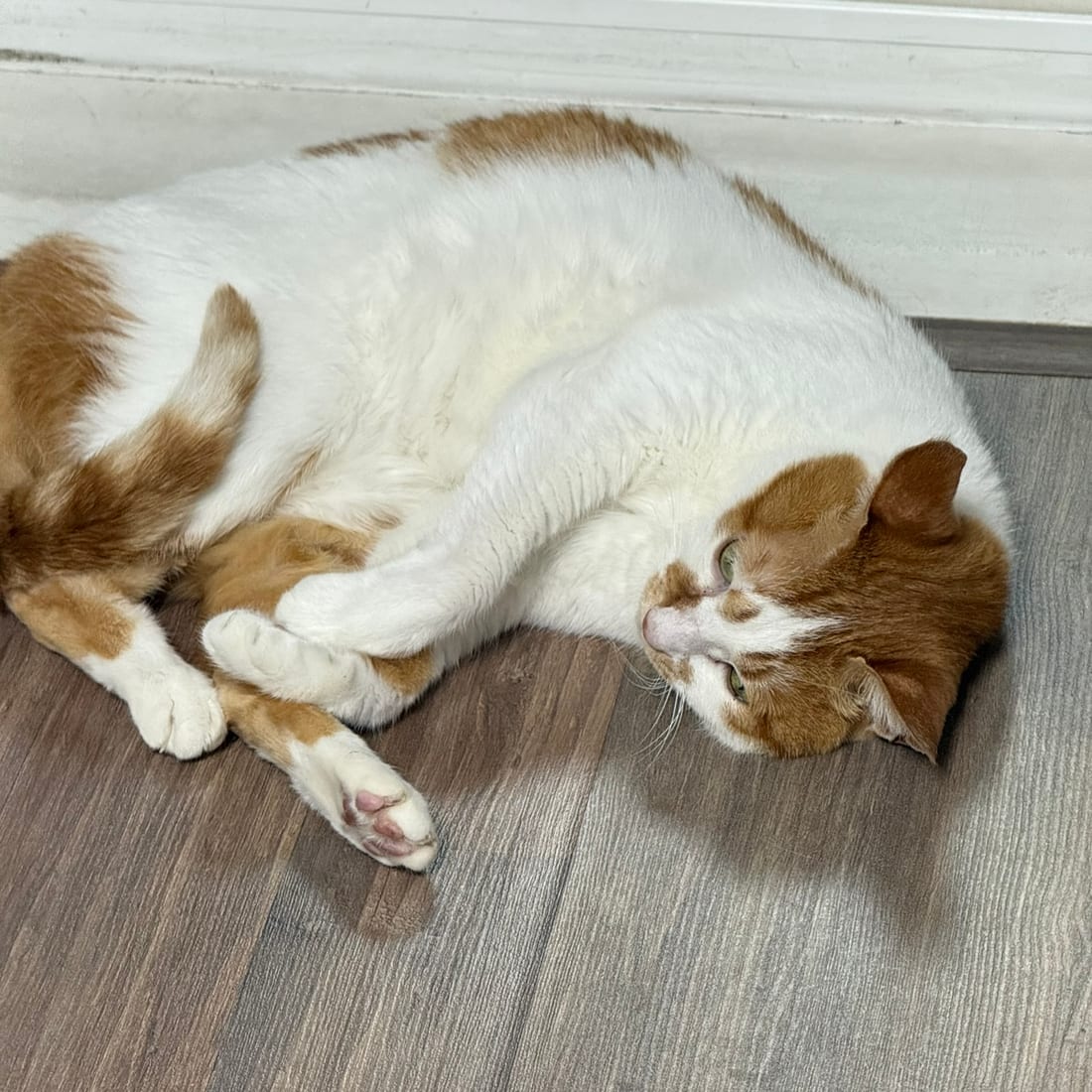
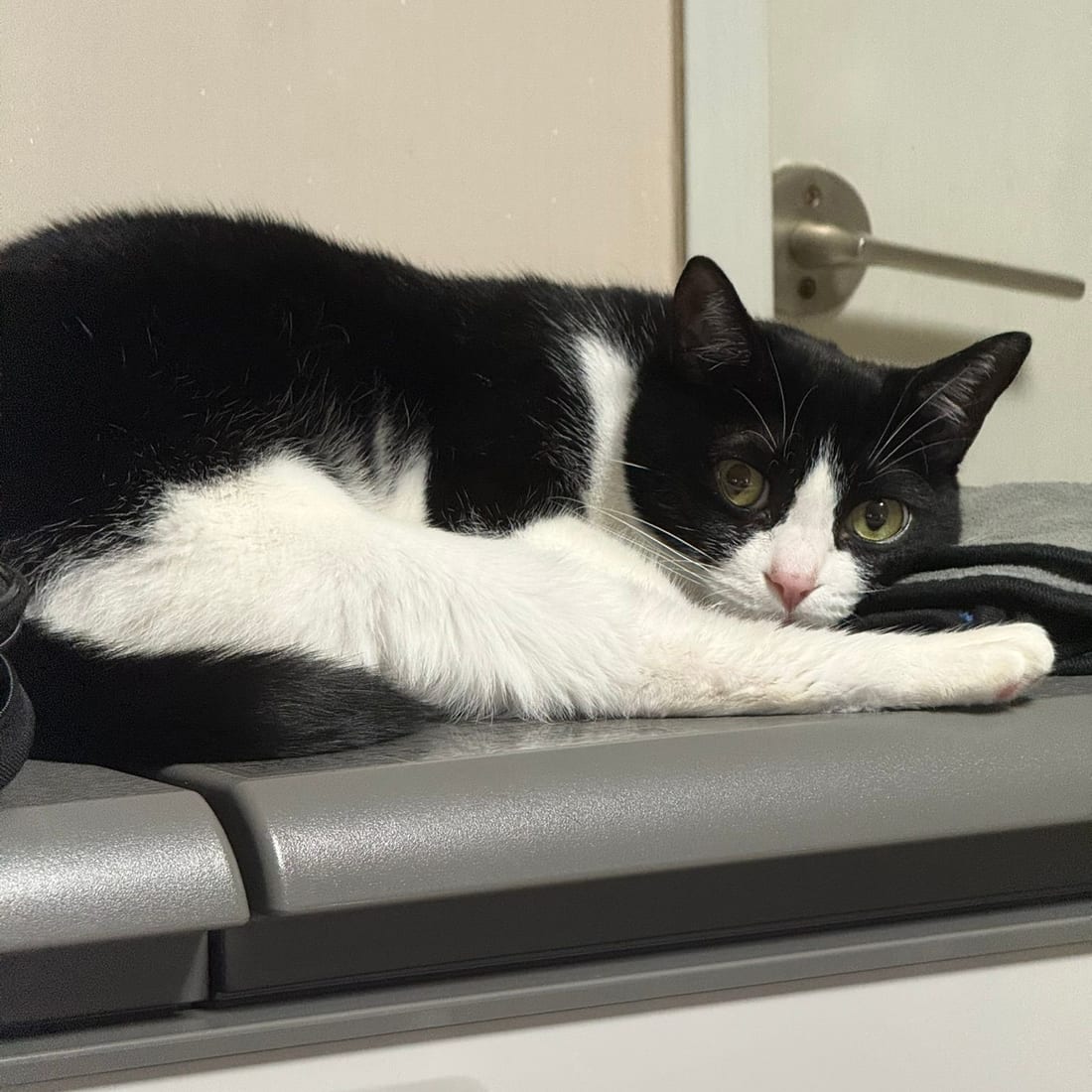
Our two came to us together six years ago. Mochi, the tuxedo, is the classic affectionate one — she headbutts, flops over for belly rubs, and purrs when she’s content, like the manual says. Yuja, the older orange-and-white one, is anxious, took four years just to let us touch her paws, and still can’t have her nails trimmed.
At some point Yuja started purring too. Great, we thought — she’s relaxing. Except she doesn’t purr when she’s content. She purrs when she wants something. She’ll come sit near me in a loaf position, ask to be scratched, and the purr is already going before my hand even reaches her. It’s not a satisfied sound. It’s a demand: look at me, come do this.
Our read is that she watched Mochi purr, saw that purring got Mochi attention and scratches, and copied the sound — but she never learned what it originally meant. She took the tool and repurposed it. She learned the “what” and skipped the “why.”
I can’t prove she learned it from Mochi. It’s our best guess after six years of watching. But she didn’t purr at all when she first arrived, and Mochi purred from day one, so the timeline fits.
Why “learning” doesn’t mean “understanding”
That purr story is the whole point of this article. When people ask if cats learn from each other, they usually picture a neat transfer — cat A teaches cat B a skill, cat B now has the skill. Real life is messier.
Cats seem to imitate the visible action far more reliably than the intent behind it. A cat watching another cat get fed after meowing learns “meowing near this spot = food,” not “the human decides when to feed me.” So they copy the surface behavior and apply it wherever they hope it’ll work.
That’s why you get a cat like Yuja purring for the wrong reason, or a cat who learned to paw at a cabinet door because she once saw treats come out of it. The copy is real. The comprehension is partial.
Does it work in the other direction too?
Sometimes people hope a calm, confident cat will “teach” an anxious cat to relax. It can help — a hesitant cat that watches a confident one eat, use the box, and move around freely will often loosen up faster than one living alone. But it’s not a personality transplant.
Our two are proof. Yuja has lived alongside easygoing Mochi for six years. Mochi eats anything, gets her nails trimmed without a fight, and greets us at the door daily. Yuja has copied exactly one visible habit — the purr — and remained her cautious self in every other way. If watching a chill cat cured anxiety, Yuja would be a different animal by now. She isn’t.
So the honest version is:
- What spreads well: concrete, rewarded actions (food routines, box use, specific attention tricks).
- What doesn’t spread: temperament, confidence, deep-seated fears. Those are more about wiring and history than imitation.
If your two cats have wildly different personalities despite sharing a home, that’s normal — we wrote more about that in two cats with opposite personalities.
How to use this in a multi-cat home
You can actually put social learning to work, gently:
- Let the confident cat go first with anything new — a new food, a new box, a new spot. The hesitant one watches and follows on her own timeline.
- Don’t reward habits you don’t want to see doubled. If you feed one cat table scraps, assume the other is taking notes. That’s how begging becomes a two-cat problem overnight.
- Don’t expect copying to fix fear. Watching a brave cat won’t undo trauma. Patience and no pressure do that work, not peer example.
- Read the copied behavior in context. If a habit shows up in the second cat, ask what reward it’s chasing. That tells you more than the behavior itself.
And keep one thing in mind: if you see a copied habit that seems off — a normally quiet cat suddenly vocalizing constantly, or a sudden change in litter box behavior — that’s worth a quick vet check, since a real change in health can look like “learned” behavior at first glance.
Cats do learn from each other. Just don’t assume they learned the reason. Ours certainly didn’t — and honestly, the purr-that-means-”pay attention-to-me” is one of our favorite things about her.
This article is general information from a cat owner, not veterinary advice. Talk to your vet about your cat's specific situation.