My Two Cats Don't Sleep Together. Is That Okay?

Yes, two cats who share a room but sleep apart are usually fine. Curling up together is one way bonded cats show closeness, but plenty of cats who get along well simply want their own spot. Whether they sleep touching matters less than whether both cats eat, use the litter box, and move around the house without tension.
Choosing to nap in the same room as another cat is already a social choice. A cat who truly couldn’t stand the other one would be in a different room entirely.
Why don’t my cats sleep together if they get along?
Most of the reasons are ordinary, and none of them have to do with a bad relationship:
- Temperature. A cat who runs warm or wants to stretch out may not want another body pressed against her.
- Preferred spots. One cat likes height, the other likes something soft on the floor. They can’t both have the top shelf.
- Personal space. Some cats tolerate touch from people and other cats only in short doses. Sleep is when they want none of it.
- How they grew up. Littermates raised together often cuddle as adults. Cats who met later in life, or spent their early lives outdoors, may never pick it up. That isn’t a rule, just a common pattern.
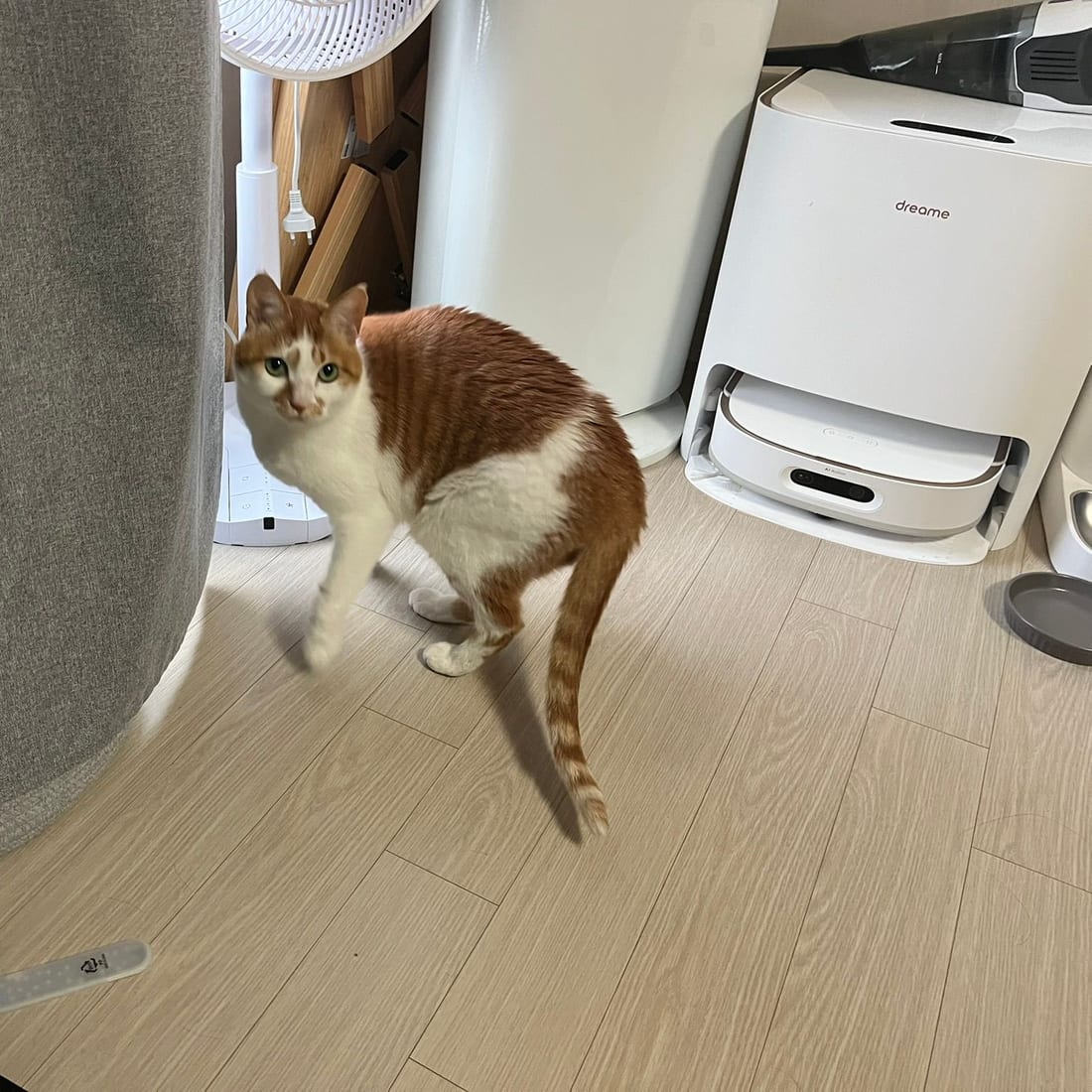
Our two are a good example. Yuja and Mochi are both 8, both formerly street cats, and they came to us together. We recently went through about 350 photos of them, and we didn’t find a single one of them sleeping pressed together. We’d stop short of saying they never do, because photos only show what someone happened to catch. What the photos do show over and over is the two of them resting in the same space, a little apart: one on an upper level of the cat tree and one lower down, one at the doorway and one on the floor, one on the sofa and one on the tree. On either side of the fan, Yuja has her basket and Mochi has her cushion.
That cushion isn’t a cat bed, by the way. We never bought one. Both of ours prefer cushions and blankets, so that’s what they get. If you’re trying to fix the “they won’t share” problem with a two-cat bed, consider that each cat may want her own spot more than a shared one.
When does sleeping apart mean something’s wrong?
Sleeping apart only matters when it shows up alongside other signs. This is a rough way to sort what you’re seeing:
| Usually fine | Worth a closer look |
|---|---|
| Different spots in the same room | One cat never enters rooms the other is in |
| Taking turns on the favorite perch | One cat guards the food, water, or litter box |
| Occasional hissing over a spot, then settling | Regular chasing that ends with one cat hiding |
| Napping within sight of each other | One cat eats less or stops using the box |
| Ignoring each other while resting | Sleeping apart started suddenly after years of cuddling |
Some friction is normal too. Yuja is the older sister, and she’ll start something with Mochi just because Mochi walked past. In many homes, the cat on the receiving end runs off, and the two end up in the same room again an hour later, in separate spots. Squabbles that are short and don’t stop either cat from getting to food, water, and their usual places are part of life in a lot of two-cat homes. If it has become one cat cornering the other, that’s a different situation, and our post on one cat bullying the other goes into what to look for.
The last row is the one to act on quickly. If two cats who always slept curled together suddenly stop, it can mean one of them is in pain or feeling unwell and doesn’t want to be touched. Cats can also start reacting to each other differently after a vet visit, since one of them comes home smelling unfamiliar. A sudden change like that is worth a quick check with your vet before you assume it’s a relationship problem.
What helps two cats rest comfortably
You can’t make cats cuddle, and pushing them together usually backfires. You can make sure neither one is sleeping apart because she has to:
- Offer more good spots than you have cats. Put them at different heights and give them different textures, like a cat tree level, a folded blanket, or a cushion on a chair.
- Put spots within sight of each other. Many cats seem to like resting where they can keep an eye on the other cat without touching. Two perches on opposite sides of a room often get more use than one shared bed.
- Separate the essentials. When food, water, and litter are spread out, neither cat has to walk past the other to reach them, and that lowers background tension.
- Leave them where they settle. Moving a sleeping cat next to her housemate “so they’ll bond” mostly teaches her the spot isn’t reliable.
If your two cats pick the same room, nap a few feet apart, and get through the day without one of them hiding, they’re doing fine. Plenty of pairs rest that way for years.
This article is general information from a cat owner, not veterinary advice. Talk to your vet about your cat's specific situation.